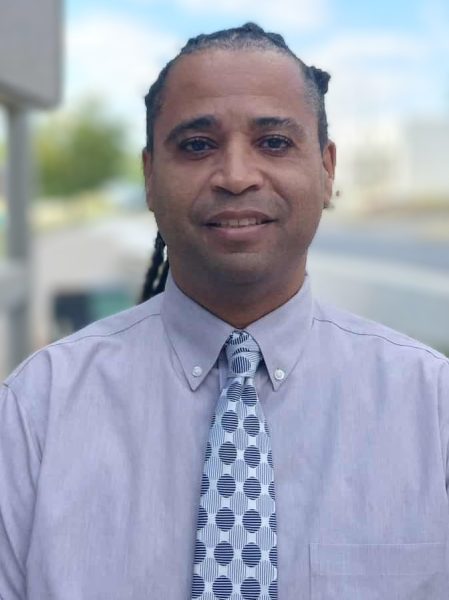
Roots 101, an African American museum founded six years ago by Louisville native Lamont Collins, serves as a space dedicated to preserving and teaching the global contributions of people of African descent. Located at 124 N. First St. in downtown Louisville, the museum is open Tuesday through Saturday and features exhibits that highlight histories many visitors were never taught.
Collins built Roots 101 with help from his daughter and others who believe in the museum’s mission. He named it “Roots 101” because, he says, the first course students take in higher education is a 101 class — a foundation. He emphasizes that understanding Black history is a process that cannot be learned in a single day. Visitors may not leave with every answer, he says, but like any meaningful education, they return for the 200-, 300-, and 400-level learning that deepens knowledge over time.
Collins speaks openly and proudly about the origins of African-descended people, calling it an honor to know one’s roots. He tells visitors that they are descendants of kings and queens who were enslaved in America, a truth he believes changes how people see themselves. When he grew up, he was taught that Black people were only slaves. Roots 101 seeks to correct that distortion. Collins says people walk and speak differently after visiting because they leave with a foundation of history that America has long withheld.
He often reflects on the equilibrium and unity that once strengthened Black communities — a balance he feels has historically been disrupted. Since enslavement, he says, Black people have been kept “off balance”; their history was hidden, and their identity was fragmented. For Collins, learning one’s history is the path back to collective strength and growth.
His motivation to establish the museum came from the lack of appreciation for Black diaspora culture he observed throughout his life. As a child, his family moved to a predominantly white neighborhood. His father, a professional race car driver and builder of churches, believed the move offered new opportunities, even when Collins felt it placed them “behind enemy lines.” His father refused to let America define him, teaching Collins the same resilience.
Collins often navigated racial tension by celebrating Black excellence. While his white peers praised white athletes, he countered with names like Josh Gibson, Wilt Chamberlain and Jim Brown. He excelled as well, becoming a standout athlete, playing football at the University of Louisville and being inducted into his high school’s Hall of Fame.
Later, when he and his wife moved into another mostly white neighborhood, they were invited to Bible study by neighbors who proudly recounted mission trips to feed “poor Black children in Africa.” Collins responded by reminding them that poor Black children lived right there in Louisville. He noticed Civil War memorabilia displayed prominently in many homes — a reminder of how differently Black and white communities are taught to view history. During one group visit to his home, a white visitor expressed discomfort in his basement because of his African-themed décor. Collins turned to his wife and said he would one day build a place that made “the comfortable uncomfortable so we all can be comfortable.” That moment sparked the vision for Roots 101.
Despite financial challenges, he pressed forward. His philosophy was “faith over finance,” a recognition that Black communities have historically relied on faith when resources were limited. Collins felt called to tell the story. After years of trial and error and several business ventures, he shifted into what he calls purpose-driven work. He begins each day committed to uplifting children and communities, ready like a preacher to pour into the next generation and remind them they are descendants of kings and queens.
He intentionally located Roots 101 in a non-Black neighborhood. Black history, he insists, is American history, and it deserved a place in the center of Louisville’s business district — an area where Black ownership is rare. The decision also challenged the historic division symbolized by Louisville’s Ninth Street boundary. Placing the museum downtown ensures that anyone walking through the area must acknowledge its presence.
Visitors to Roots 101 are predominantly Black, including many college groups from Chicago. Collins explains that while he receives strong support from institutions outside the region, there is far less engagement from local HBCUs. Despite the museum’s educational value, he says Kentucky State University and Simmons College have not fully utilized Roots 101 as a teaching tool or internship site, even though professors nationwide recognize the museum’s offerings as collegiate-level. He is preparing for a major appearance on Urbanview Channel 126 on the Marc Lamont Hill and Dr. Carr Show.
Collins places the museum within the broader history of HBCUs in Kentucky — institutions built through Black struggle, resilience, and scarce resources. He notes that Simmons College was founded by 12 formerly enslaved people, that Jonesville — a 30-acre Black town — was taken to expand Western Kentucky University, and that even Kentucky State University’s president once resorted to humiliating blackface performances to secure state funding. He cites scholars such as Craig Steven Wilder, Chancellor Williams, Cheikh Anta Diop, and George G.M. James to emphasize that African civilizations were the world’s first centers of learning.
Social media has become a vital tool for Roots 101, offering affordable visibility. Collins recently reached 10 million views on a single post. He prides himself on creating an experience that “makes the comfortable uncomfortable,” as visitors of all backgrounds are invited to put on replicas of shackles to feel the weight of 400 years of trauma.
Although Roots 101 charges admission, the museum remains accessible. Despite funding challenges, it has welcomed 65,000 visitors, many from outside Louisville. Collins acknowledges that the museum does not yet receive the tourist traffic of major local attractions like the Louisville Slugger Museum, but he is confident Roots 101 will continue to grow.
He also emphasizes that throughout American history, white allies have supported Black liberation efforts — from slavery to Reconstruction to the founding of universities. Collins believes telling a complete story requires acknowledging both Black resilience and the white allies who risked everything to stand alongside Black communities. True progress, he says, comes when Black and white people move forward together as “better ancestors.”
He reflects on harmful narratives that discourage immigrants from identifying with Black Americans, despite the long history of Black exploitation in media and society. He argues that both groups are stronger when they move in unity rather than seeing their struggles as separate.
Recent movements — including those sparked by the death of Breonna Taylor and the rise of Black Lives Matter — have encouraged more Black artists and cultural practitioners to share their work. Collins says African visitors often view Roots 101 as “coming home,” sometimes leaving artifacts in the museum’s care. Traders spread the word, urging others to bring items to the museum. He cites Malcolm X’s call for global Black unity, insisting that if people say they matter to one another, then they must matter together.
Collins rejects the idea that Louisville doesn’t need more than one Black museum. He notes that the city hosts several museums dedicated to white history and culture, such as the Speed and the Frazier, so there is no reason Black history should be confined to a single institution. The story is vast, he says, and can be told in many ways. His own storytelling draws from memory, in the tradition of African griots and scribes who preserved history for generations.
One of his favorite exhibits is “Big Momma’s House,” inspired by the elders who passed down stories, displayed family photos, and taught younger generations that they could succeed. Collins calls himself a modern-day abolitionist. He may not have millions of dollars like larger museums, but he believes he has a responsibility to tell the story because it needs to be told.
He reminds visitors that Black history is not confined to February. Carter G. Woodson created Negro History Week in 1926, and President Gerald Ford expanded it to a month in 1976, but Roots 101 honors Black history 365 days a year. The museum has welcomed visitors such as Nick Cannon, attorney Ben Crump, Fred Hampton Jr., and Bobby Seale, along with people from around the world.
For more information about Roots 101, visit roots-101.org.