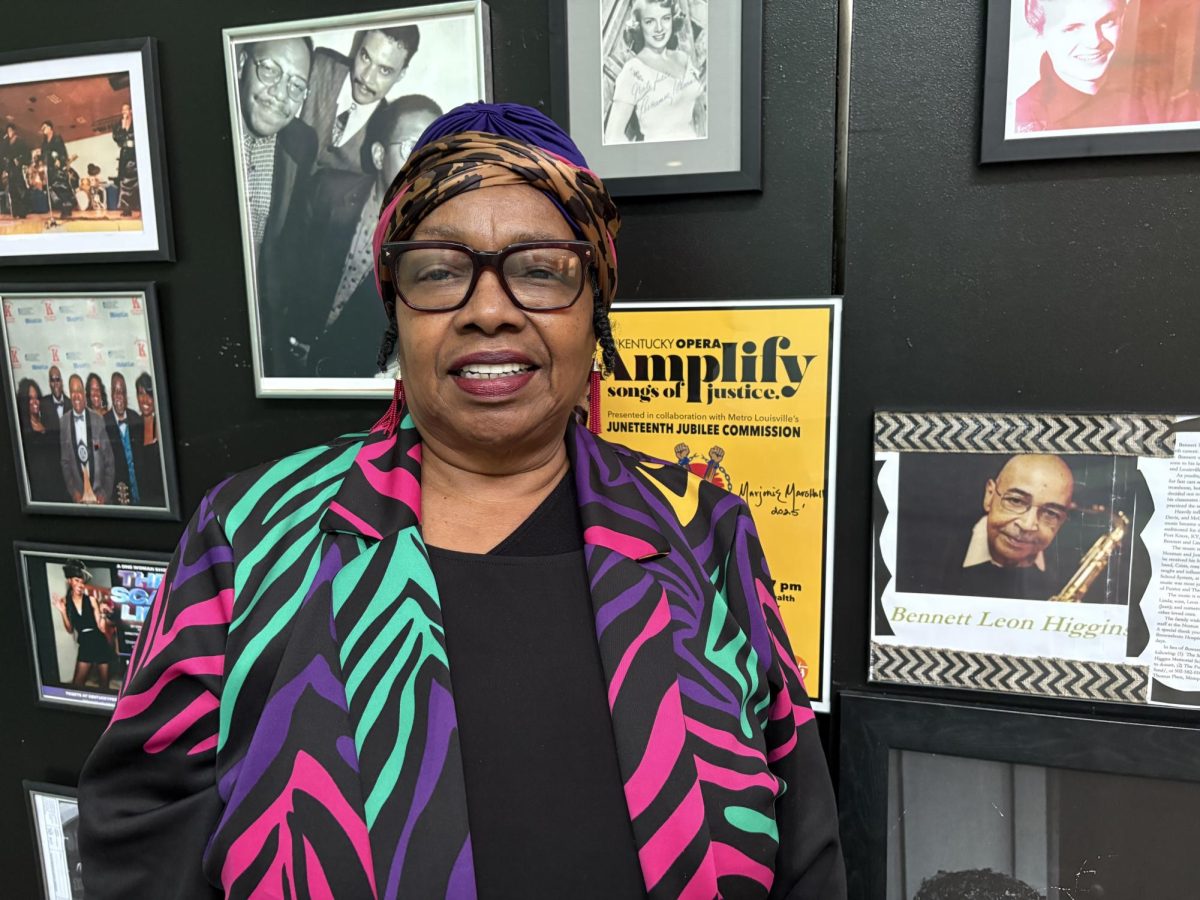
On her journey to build a dream project to honor those who leave legacies for generations to follow, Marjorie Marshall has been doing this work for a long time. Under the friendship and mentorship of the late soulful singer Mary Ann Fisher, for almost 20 years, Marshall learned what it takes to be a disciplined music entertainer.
“People thought Mary Ann Fisher was a drug abuser, but she wasn’t,” Marshall said. “She wasn’t a Raelette nor a background singer. She was the first featured female singer to sing with the Ray Charles band.”
Marshall, along with two of her friends, Ron Lewis and Robert “Butch” Williams—also music artists—established a television show through Insight Cable in Louisville, Kentucky, in the 1990s. According to Marshall, it was her friend Butch who initiated a music-focused talk show because of the legendary Mary Ann Fisher.
“Butch initiated a talk show around music because of the one and only Mary Ann Fisher,” Marshall said. She also noted, “She wasn’t from Louisville, Kentucky. She was from Henderson, Kentucky.”
Marshall, who used to be a cosmetologist, said, “I didn’t know at the time Mary Ann Fisher lived over at the old Madison Junior High School, which they turned into a senior citizens home. And I worked across the street as a cosmetologist.” Because of Fisher’s association with Ray Charles, people assumed she used drugs. It’s a known fact that Charles struggled with addiction. At one point in her career, it was hard for Fisher to collaborate with other music artists.
“Mary Ann Fisher smoked a little weed, but she said she didn’t like it,” Marshall said.
Marshall said her friend Ron Lewis “had a band” and also had a production company called Mister Wonderful Productions. “He and a gentleman by the name of Robert Butch Williams had an organization called Star Gazer. That’s his brand,” she said.
When karaoke became popular, Marshall, Lewis and Williams performed at a spot in Louisville known as Joe’s Palm Room.
“So we had an organization called Louisville Association of Music Performers,” Marshall said. “Local musicians—because many of them, that was their livelihood, how they fed their families doing live music—didn’t have insurance. We would raise money for the families. So it became very, very popular.”
It grew to the point where every year they created their own Grammy-style awards show, she said, giving honors such as best new artist and best female artist based on who was doing notable work. “Miss Fisher won our first-ever lifetime achievement award,” Marshall said. The organization lasted for a while before it eventually fizzled out.
Lewis and Williams eventually decided to form a music label.
“Butch and Ron, because they were consummate musicians, got together and decided they wanted to develop a label, and they called it ‘The Soulful Sounds of Derbytown,’” Marshall said. “They would record a lot of the prominent recording artists here from Louisville.”
“We had a lot of artists who left Louisville and played in famous bands. We have Johnny Graham—still plays with Earth, Wind & Fire,” Marshall said. “And then of course Miss Fisher resided here in Louisville, Kentucky.” They produced compilation albums and brought in Cliff Butler of WLOU, back when William Summers III became the first Black person to own a radio station. “This was a vehicle whereby we could honor and showcase our own local talent,” she said.
Williams wanted a radio format to further Louisville’s music endeavors, but nothing came of it.
“So Butch came up with the idea to do a radio program, but it didn’t go over very well,” Marshall said. “He decided to walk away from the project. When he and Ron put the project away, I picked it up because I didn’t want to see it go away.” She continued, “I went and found out what kind of money it was going to take to be on the radio. I didn’t have a lot of money, but I went with my little pennies.”
Marshall’s first experience in the recording studio in the late 1990s helped her connect with other musicians in her community. Cliff Butler, known as “The Voice” on WLOU, had a recording studio in his church where his son Lamont Butler assisted Marshall in producing music.
“In the late ’90s when I first began recording music, it was under the auspices of Lamont Butler,” she said. “We did all of this great music even back then. But we didn’t know how great it was, because the only people who heard it were our own family and friends.”
“When I took it upon myself to be on this radio program, ‘The Soulful Sounds of Derbytown,’ we began to spin that music,” she said. “The quality we had accomplished—I was just overjoyed and overwhelmed.” The Kentucky Center for African American Heritage sponsored a two-hour program for a year.
The Soulful Sounds of Derbytown airs Sundays on WLLV 1240 AM and 101.9 FM from 4 to 6 p.m.
“I do live interviews; I bring in local musicians,” Marshall said. “Some come and play live over the air. They bring their music in; I spin their music live over the air. It’s not only a wonderful thing for the artists—it’s a wonderful thing for the community.”
A book titled The Soulful Sounds of Derbytown was written by six authors, including Marshall’s friend Ron Lewis, along with Ken Clay, Michael L. Jones, Wilma Westfield Clayborn, Keith Clements and Gary Falk. It took eight years to complete. At the 2025 Independent Publisher Book Awards, the book won the Gold Medal for Best Regional Nonfiction (Southeast) and the Silver Medal for Nonfiction Oversize Book Cover Design.
The book is the first of its kind documenting the various musical genres African American artists performed during and after segregation in Louisville, Kentucky. The artists featured performed locally, nationally and internationally through venues such as movies, television, festivals and theater. The book includes illustrations, photographs, written materials and contributions from people involved in the artists’ lives.
Ken Clay, president of Legacies Unlimited and known as a hometown hero in Louisville, produces the annual “Walnut Street Revue” to pay tribute to the Soulful Sounds of Derbytown artists, usually held at the Kentucky Center for African American Heritage.
Marshall says she learned how to “ride the wave” early in her career. “When I got into singing and performing professionally, I was a female with five guys. I’ve learned to ride the wave,” she said.
Marshall’s passion for music has not only led to a radio program but also to a foundation. She serves as president of the Kentucky Heritage Music Foundation, a project she was passionate about because there was no historic institution documenting Black contributions to music in Kentucky. According to Marshall, there were only three music museums in Kentucky before the foundation was established—in Owensboro, Prestonsburg and Renfro Valley, where the Kentucky Music Hall of Fame is located.
Before Marshall and her supporters established the foundation, other groups were trying to create similar institutions.
“There were two other organizations attempting to do what we’re doing now,” she said. “It operated under the Louisville and Kentucky Music Museum. But since we don’t have a brick-and-mortar location of our own, the Kentucky Center for African American Heritage allowed the Kentucky Music Heritage Foundation to come in to make our organization visible. We chose to stick to that name.”
In 2012, Marshall, Williams and Lewis produced a program at the Kentucky Center for African American Heritage.
“We came to the Kentucky Center and asked about doing a program. At that time the Center was in transition. Rita Phillips was over the Center and allowed us to do a ‘Women in Music’ program,” she said. “Long story short, it morphed into a really big opportunity not just for local artists but for us as an organization.”
Marshall formed a board for the Kentucky Music Heritage Foundation, with the main objective of curating and housing music of local and regional artists. “Of course, we’re working on trying to get a brick and mortar of our own,” she said. The original board later became dysfunctional.
“Mr. Aukram Burton, who’s the director now, and Mr. Mitchell signed us on to come into the Kentucky Center for African American Heritage to make our organization visible,” Marshall said. “We’ve been housed here for a number of years. They’ve been very kind and forthcoming, allowing us to make our project visible. It’s been a great experience because of the traffic that comes through here due to the other exhibits. People get a one-of-a-kind experience and education about musicians and artists in Kentucky.”
Marshall said she has been fortunate to work with Joan Shelley of Heartland Songwriters.
“The only person I can depend on is Heartland Songwriters,” she said. “They deal with musicians and artists. Everything they deal with is original music. Joan Shelley was elected secretary of the Kentucky Music Heritage Foundation when it transitioned from the original board. And she’s been true to the cause. She understands the ins and outs of everything. I can depend on her,” Marshall said. “She’s the one who made our Facebook page.”
Another person Marshall values is Doug Van Buren, a longtime collector of music paraphernalia who has gathered 50,000 Christmas songs and more than three-quarters of a million songs overall. He began collecting 45s at age 14.
“There’s a gentleman by the name of Doug Van Buren; he used to be a DJ in the city,” she said. “Doug now resides in Atlanta. He moved away many years ago, but we were also consummate collectors like Butch.”
“Butch was a consummate collector—not just of records, but music memorabilia,” she said. “There wasn’t anybody you could mention musically that Butch didn’t know something about. And Mr. Van Buren was the same way.”
Two years ago, Van Buren donated his entire collection to Louisville under the umbrella of the Kentucky Center for African American Heritage. “Upstairs, there’s a whole room filled to the brim with musical artifacts, information and merchandise,” Marshall said.
Marshall is also supported by others, such as producer Anne Gauthier of La La Land Recording Camp, who trains 13- to 18-year-olds in the recording process, and David Christopher Jr. of AMPED Music Academy, who has expanded into technology and business training. Marshall recently met with Simmons College of Kentucky President Kevin Cosby to explore ways to inspire students to learn about Kentucky’s musical heritage.
Marshall pinpoints local artists who have made an impact regionally and internationally. She recalls talented banjo player Leon Bibb, tied to the Bibb lettuce family. She remembers seeing a young Tasha Scott perform in clubs alongside adults. According to Marshall, she was Scott’s and her mother’s cosmetologist.
“When Tasha Scott was a child, she used to come to the Palatium,” she said. “She’d be in there singing her heart out.”
Scott, born and raised in Louisville, eventually got her break on “Star Search,” the equivalent of today’s “America’s Got Talent.” She recorded music with Michael Jackson under his MJJ label, with Brandy Norwood and others. She was encouraged to be versatile and pursued acting as well, appearing in television shows such as “227,” “The Jeffersons,” “Quantum Leap,” “Amen,” “Full House” and “Webster.” Her film credits include “Troop Beverly Hills,” “Kiss Shot” and “Camp Cucamonga.” She also had recurring roles on “Snoops,” “The Parent ’Hood” and “South Central,” and played Dorothy in stage productions of “The Wiz.” She continues to work in the entertainment industry in Atlanta.
Marshall also discusses Underground Mafia, a popular Louisville rap group that recorded hits such as “The Godfather” and “Gangsta Walk,” predating other Louisville artists such as L.A. Ganz, L. Young, Playa, Static Major, My Morning Jacket, Nappy Roots, Nicole Scherzinger, Jason Clayborn, Linkin’ Bridge, Bryson Tiller, Jack Harlow, EST Gee, Vory, 2KBaby and more.
“When Underground Mafia recorded back in the day and went to New York to record their hit ‘Gangsta Walk,’ they were questioned by an executive about whether Kentucky people wore shoes,” Marshall said. She continued, “The executive offered Underground Mafia a multimillion-dollar contract but told them not to mention they were from Louisville, Kentucky. They got to control the narrative. Do what they say, or else.”
Marshall said that in political terms, “inclusivity” often means exclusion if you’re not financially in control.
“They want to create you. They want to say they found you, like Columbus discovered America,” she said. “You have to understand this is a slave state. It will always be a slave state.” She added, “Louisville, Kentucky—Kentucky overall—was the melting pot. People settled here. Some left; some didn’t. Black people didn’t know who was looking,” referring to slave masters searching for escaped enslaved people.
“People have a concept of what things should be,” she said. “When you have the opportunity to control the narrative, you control the narrative. Don’t let nobody tell your story.” Marshall said she wants to help develop talent. “I want to help develop an artist incubator,” she said. “People can sing, but they have no discipline. If this is your passion, you’ve got to be disciplined. Discipline is what you do to do better. You’ve got to work.”
“Chadwick Boseman put in the work. He made you believe he was James Brown,” she said. “You want to be the Celine Dions, the Aretha Franklins; you want to be the James Browns of the world. You have credibility by the work that you do.”
“When you trace Black music, you’ll find Black artists didn’t get credit for their music,” she said. “They were sampling our stuff for years. Black people didn’t get royalties. Not giving credit where it’s due.” She added, “Whatever thought comes to my head.”
“When people in the church are speaking in tongues, that’s our native tongue,” she said.
“Enslavement is not a thing of the past,” Marshall continued. “It can happen overnight, and you won’t even know it happened. If you don’t control the narrative, you’re being controlled. We have to learn to control the narrative. And we’ve done it before. We did it before Reconstruction. We were free the day we came out of our mother’s womb. The good Lord made you free. Let’s not be confused about what the real issue is. And when you’ve been conditioned in dysfunction, you’re going to operate in dysfunction. You must understand the almighty dollar is controlling the narrative. Always has, always will.”
Marshall understands the trials Black people have gone through to keep their culture safe from exploitation. She gives an example of Black children being separated from their families—Black boys in particular.
“Now the uncovering of this information—BCE history,” she said. “The Bible is our history. You have to understand, when they took the Black males out of the homes strategically, they took the strongest Black man, put him in front of the whole community and tore him apart. Black females became overprotective of their sons, of their children in general—especially their sons. So what happened was…” She paused. “Look what’s happening. They’re taking away the SNAP, they’re taking away the Section 8. We’re the poster children for everything that is wrong.”
She continued, “So the Black female had to become the mother, the father, the sister and the brother to her children. You had to work and still provide and make a home for your children. We lost our sense of pride and productivity. We became consumers instead of producers. We were always producers—always.”
Marshall’s questioning of who will protect children reflects today’s concerns about missing Black children and who will protect Black culture, inventions and institutions. She knows Black women warriors were powerful in Africa—as depicted in “The Woman King,” starring Viola Davis—and that they continue to be powerful throughout the African diaspora. She spoke about the drum, saying, “Certain areas on the hands on the drum denote certain words.” The drum has long acted as a form of communication. “Our history traces back to Africa,” she said.
Marshall shared an intriguing story about an encounter with ancestors from the spirit world while rehearsing for a stage play in Nashville, Tennessee, at the Scarritt-Bennett Center.
“To me it’s an outer-body experience,” Marshall said. “The first time I went to Scarritt-Bennett for a performance— that theater is built over a slave grave.” She said, “It’s like an outer-body experience. Because you hear yourself, but there’s nothing you can do about it.”
During rehearsals for a play titled Stories from the Dirt, in which she played an ancestor, she described a moment when she felt overtaken by a spiritual force while singing “Ain’t No Grave Gonna Hold This Body Down.” She said she began crawling on all fours and howling, causing a photographer to drop his camera and the lighting technician to run out of the room.
The playwright, who had been named a chief in Africa due to her work there, told Marshall afterward, “I heard many African dialects, but I haven’t heard that one.” The cast formed a circle around Marshall and prayed until she became calm again. “After that I couldn’t speak,” Marshall said. “I didn’t open my mouth again until we had to do that play.”
Marshall, who has long worked in music, knows how to meet young people where they are.
“Children with autism are geniuses,” she said. “It’s good to listen to the music and groove to the sounds, but can you make somebody feel it? We need young people whose passion is music and performance art—and all the ones in between and after. You don’t want to badger anybody; you want their talent to grow. You have to have a mind of discipline. You have to have a passion for excellence. Because even if you’re good and you know you’re good, you can always do better.”